Somewhere between CIM distribution and the IOI deadline, every sell-side process goes quiet. The document went out to twenty-five NDA-signed buyers. The process letter set a date. And now the deal team waits, inferring interest from whatever signals leak through: who asked a question, who took the check-in call, whose associate sounded engaged. It’s tea-leaf reading, performed by expensive people.
Here’s the thing – the real answer exists. Every one of those buyers either opened the CIM or didn’t, spent forty minutes in the financials or skipped them, came back three times or never returned. CIM engagement tracking turns the quietest three weeks of the process into its most informative. This post is about what that data shows, how bankers actually use it, and why the traditional way of sending a CIM makes the question unanswerable.
The quietest three weeks in M&A
When the CIM goes out as an email attachment, the deal team’s visibility ends at the send button. What comes back before IOIs is noise with occasional signal: a Q&A question here (good sign), a canceled call there (bad sign?), and a lot of polite nothing. Bankers compensate with check-in calls that buyers have learned to answer noncommittally – nobody tips their hand three weeks before a bid.
The cost isn’t just anxiety. Management’s time is the scarcest resource in a process, and without engagement data it gets allocated by guesswork – hours spent preparing for a buyer who, it turns out, never opened the document, while a quietly serious bidder gets the standard treatment. Real CIM tracking replaces that guesswork with a log.
What the data actually shows
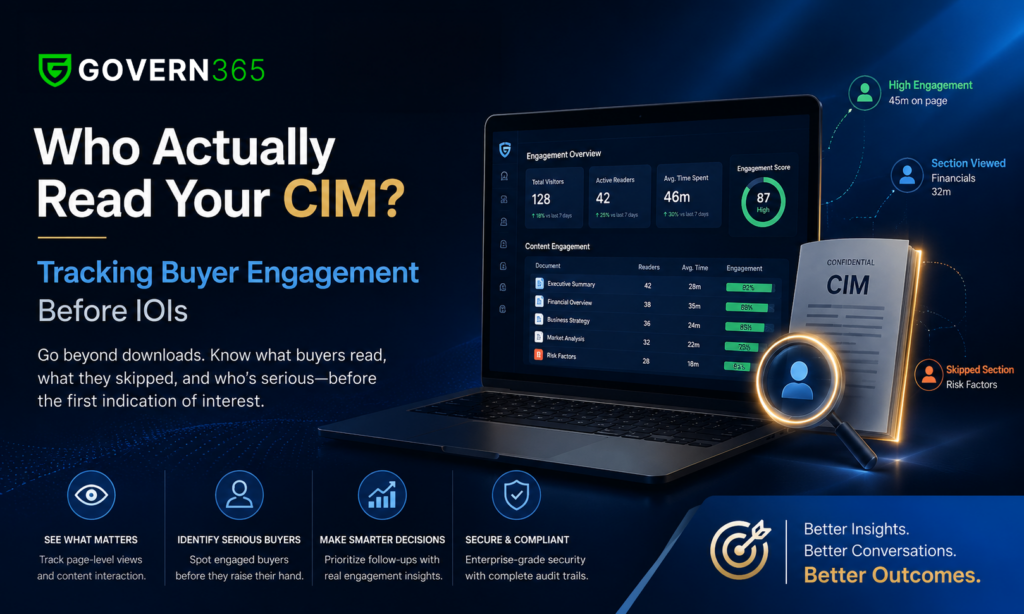
Deliver the CIM through a governed environment instead of an inbox, and every interaction becomes visible, per bidder: who opened it and when, which sections they read, dwell time per section, and how many times they came back. (This is a byproduct of doing CIM distribution properly – view-only, watermarked, identity-verified access happens to be measurable access.)
After enough processes, the patterns become recognizable. I’ll give you the four we see most.
The Studier. Opened the CIM within hours of access. Forty-plus minutes in financial performance, repeated visits to the adjusted EBITDA bridge, then the growth section. Often a second reader from the same firm appears within days – an operating partner, someone from their deal counsel. Studiers submit IOIs, and their bids are grounded in your numbers, which makes them defensible in later rounds.
The Skimmer. Opened it the day it arrived, twelve minutes cover to cover, heaviest on the executive summary and transaction overview. Skimmers aren’t dead – some firms triage first and study later – but a skim with no return visit by week two usually means you’re a comp for a deal they’re doing elsewhere, not a target they’re pursuing.
The Ghost. Signed the NDA, received access, never opened the document. Ghosts are the most valuable pattern to catch early, because they’re the buyers the traditional process wastes the most time on – the NDA signature created an impression of interest that fifteen minutes of data disproves.
The Second Look. Quiet for two weeks, then sudden concentrated reading right before the IOI date – often triggered by their internal committee meeting. Second Looks are why you don’t write off a quiet bidder too early, and why the timing of engagement matters as much as the amount.
What bankers do with it
The point of buyer engagement analytics isn’t surveillance; it’s allocation. Management presentations, facility visits, and expert calls go first to Studiers. Check-in calls to Skimmers get sharper – “did the financials answer your questions?” lands differently when you know they never got there. Ghosts get one nudge, then get deprioritized without ceremony. And when the CEO asks how the process is going, the answer is a table, not a mood: eighteen of twenty-five opened it, six show deep engagement in financials, two brought outside counsel in.
There’s also a quieter effect on process tension. Buyers who know engagement is visible – and watermarked, identity-verified access makes that legible – behave like participants in a competitive process, because they can see the seller is running one.
A caveat, so the data stays honest
Engagement predicts attention, not price. A Studier can still lowball you; a Second Look can win the auction. The data’s real power is negative space: in years of watching these processes, buyers who never meaningfully engaged with the CIM almost never submit meaningful IOIs. Presence of engagement is a lead; absence of engagement is close to an answer. Use it to spend your time, not to write your bid grid for you.
Why your current process can’t answer the question
If the CIM goes out as a PDF attachment, none of this data exists. Email read-receipts tell you nothing about the document; “tracked links” break the moment someone downloads and forwards the file. The analytics only exist when the document never leaves governed custody – a virtual data room for CIM delivery rather than an inbox – which is exactly how Govern 365 does it: view-only, per-recipient watermarked access inside the seller’s own Microsoft 365 tenant, provisioned by the NDA signature itself, with per-bidder analytics accruing from the first open. The same environment covers the months before go-to-market too, doubling as the CIM drafting software while the document is being written. Control and intelligence turn out to be the same feature.
Frequently asked questions
Only if it’s delivered as governed, view-only access rather than an attachment. In that model, every open, section view, dwell time, and return visit is recorded per named viewer. Once a PDF is emailed, no reliable tracking survives the first forward.
Per bidder: who opened the document and when, which sections they read, time spent per section, return visits, and how many people from each firm engaged. Aggregated, it’s a live ranking of buyer attention across the pool.
Buyers in governed processes understand that identity-verified, watermarked access is logged – it’s standard practice and part of what signals a well-run auction. Most bankers find it sharpens buyer behavior rather than chilling it.
Directionally, yes – deep, repeated engagement (especially in financials, and especially by multiple readers from one firm) correlates strongly with serious IOIs. The strongest signal is negative: buyers who never engage almost never bid meaningfully.
No. Read receipts track the email, not the document; link trackers die at the first download-and-forward. Engagement analytics require the document to stay in governed custody for its whole life.
It’s your document and your process; access logging is disclosed standard practice in data rooms. Where teams draw the line is using it for allocation and prioritization – which is fair game – versus quoting a bidder’s reading habits back to them, which nobody should do.
Related reading
- The Complete Guide to the Confidential Information Memorandum (Coming soon)
- How to Distribute a CIM Without Losing Control of It
- NDA-to-CIM Workflow: Automating Buyer Access After Signature (Coming soon)
- Govern 365 for Sell-Side M&A: The Entire Seller Journey in Your Tenant
- Explore the Govern 365 Virtual Data Room
See your buyer pool the way the data sees it. We’ll show per-bidder engagement live – sections, dwell time, return visits – in a Govern 365 demo tenant. Book a personalized demo.