There’s a specific moment in every sell-side process when the risk profile of the deal changes, and it isn’t the management presentation or the LOI. It’s the Tuesday afternoon when the CIM goes out. Up to that point, the most sensitive document your company has ever produced existed in one place, seen by a handful of people under NDA. An hour later it’s in thirty inboxes, and the honest answer to “where is our CIM right now?” is: nobody knows.
CIM distribution gets treated as a logistics task – build the list, hit send, start chasing IOIs. It deserves to be treated as what it actually is: a custody decision. This post covers what goes wrong with the way most CIMs are sent, and the five controls that let you share the document widely without ever giving it away.
The moment you hit send
Walk through what happens when a CIM goes out as an email attachment, because the mechanics matter.
The banker sends the PDF to the deal contact at each NDA-signed buyer. That contact forwards it to their internal deal team. Someone forwards it to their corp dev lead, who sends it to an operating partner, who is also on the board of a company in your space. None of these forwards is malicious. Every one of them is invisible to you. Within a week, the realistic circulation of your CIM is three to five times your buyer list, and you cannot name the people holding it.
Then there’s the timeline problem. A buyer who signs the NDA in week one and exits the process in week three still has the document in week thirty. NDAs create a legal obligation to return or destroy it; they do not create the ability to verify that anyone did. I have never met a deal team that followed up on destruction clauses for every dropped bidder. There’s no mechanism to.
What losing control actually costs
It’s tempting to file this under theoretical risk. It isn’t theoretical. A CIM contains your margins, your customer economics, your growth plan, and your reason for selling – the exact information a competitor would pay for, laid out persuasively, and now moving through inboxes you’ve never heard of.
The damage shows up three ways. A leak to employees or customers destabilizes the business mid-process, which is precisely when it can least afford turbulence. A leak to a competitor arms them for the years after the deal, whoever wins it. And a leak into the market chatter can reprice or kill the process itself – buyers walk from auctions that feel compromised. Sellers spend enormous energy on what goes into the CIM and almost none on what happens to it after it leaves. That ratio is backwards.
The five controls of governed CIM distribution
Here’s what it takes to send a CIM to buyers and keep custody of it. None of these is exotic; the point is that they have to work together, on every copy, automatically.
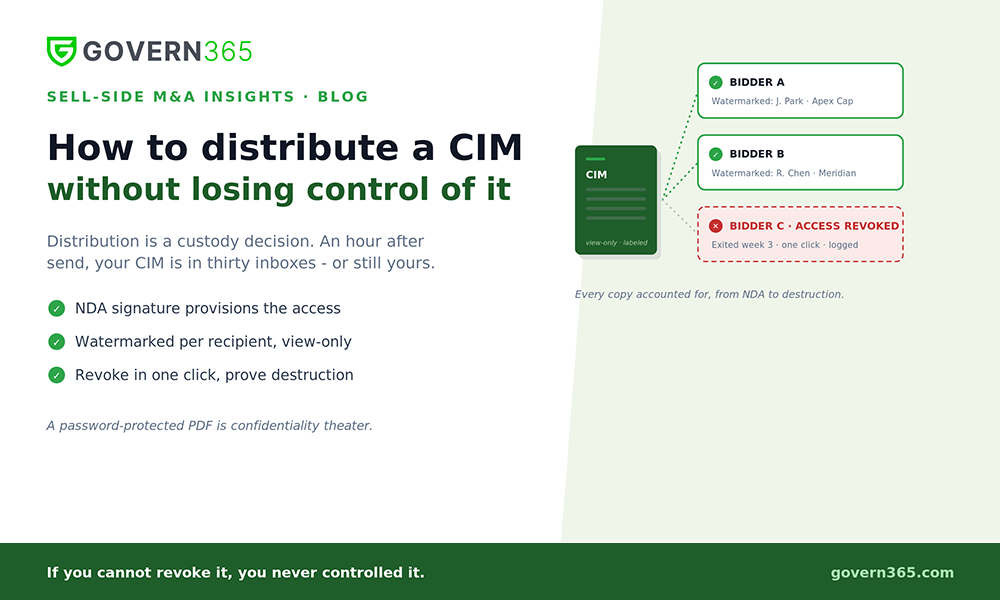
1. Let the NDA provision the access. In most processes the NDA is signed in one system and the CIM is sent from another, with a human bridging the two. That bridge is where mistakes live – the CIM sent before the NDA is countersigned, or sent to the wrong contact entirely. In a governed process the signature event itself provisions access: buyer signs, and their NDA-gated access to the CIM exists from that moment, view-only, under their verified identity. No bridge, no gap, and a clean line in the record from legal permission to actual access.
2. View-only, not download. If the file can be downloaded, every control after that point is a suggestion. View-only CIM delivery means the document renders in the browser under your policies – no local copy, no print path, no attach-and-forward. The buyer’s deal team reads everything they need to write an IOI. What they can’t do is create copies you’ll never see again.
3. Watermark every page, per recipient. CIM watermarking done properly is dynamic: each viewer sees their own name, firm, and timestamp on every page. It works twice. Forensically, a leaked page traces to its source. Psychologically – and this is the part people underrate – nobody screenshots a page with their own name stamped across it. The watermark turns every recipient into a careful one.
4. Watch the engagement. Governed distribution tells you who opened the CIM, which sections held them, and for how long, per bidder. That’s process intelligence (the buyer who spent forty minutes in your financials is not the same as the one who never opened the file), and it’s also a control: unusual access patterns surface while you can still act on them, not in a post-mortem.
5. Revoke in one click, and prove the ending. The buyer who exits in week three should lose access in week three – one click, effective immediately, logged. And when the process closes, every outstanding copy gets revoked and destroyed with a certificate to prove it. That’s the difference between “the NDA says they’ll destroy it” and “here is the record showing they no longer have it.”
What this looks like in practice
In Govern 365, the whole sequence runs inside the seller’s own Microsoft 365 tenant. The CIM never migrates to a vendor’s cloud; buyers come to the document, as Entra ID guests, rather than the document going to them. Purview sensitivity labels and DLP policies travel with the file. The NDA signature auto-provisions each buyer’s access; every page is dynamically watermarked; engagement analytics accumulate per bidder; revocation is immediate; and the close of the process produces an audit trail from first access to certificate of destruction. Distribution stops being the moment you lose the document and becomes the moment you start governing it.
“Can’t we just password-protect the PDF?”
The question comes up on every deal, so it’s worth answering directly. A password-protected PDF is confidentiality theater. The password goes out by email – often in the same thread – and travels with every forward. Once opened, the file saves, prints, and re-attaches like any other PDF, and PDF password removal is a solved problem free tools handle in seconds. It signals diligence without providing any. If the material justifies protecting, it justifies protecting with controls that survive the send button.
Frequently asked questions
Traditionally as a PDF attachment emailed to each NDA-signed buyer, sometimes through a data room link. The email approach offers no watermarking, no tracking, no revocation, and no forwarding control – which is why governed processes deliver the CIM as view-only, per-recipient-watermarked access provisioned by the NDA itself.
Not with an attachment – once a file is in someone’s inbox, forwarding is invisible to you. You can prevent it structurally: view-only delivery means there is no file to forward, and anyone needing access gets their own identity-verified, watermarked view instead.
Each viewer sees their own name, firm, and timestamp rendered on every page of the same underlying document. Leaked pages trace back to their source, and recipients handle the document more carefully because it’s visibly theirs.
In a governed environment, in one click – access ends immediately and the action is logged. With emailed attachments, revocation is impossible; the NDA’s return-or-destroy clause is a promise you cannot verify.
No. The password travels by email with the file, forwarding is uncontrolled, and the protection strips out with freely available tools. It provides the feeling of security without the substance.
In most processes, nothing – they persist indefinitely in buyers’ systems. A governed process ends with revocation of all outstanding access, destruction of buyer copies with a Certificate of Destruction, and a retained audit record for the seller. See how this fits the full journey in Govern 365 for sell-side M&A.
Related reading
- The Complete Guide to the Confidential Information Memorandum (coming soon)
- CIM Example: What a Buyer-Ready CIM Actually Looks Like
- CIM Software: Tools for Drafting, Distributing, and Tracking a CIM
- Govern 365 for Sell-Side M&A:The Entire Seller Journey in Your Tenant
- Explore the Govern 365 Virtual Data Room
Watch a CIM go out and come back. In 30 minutes we’ll run the full distribution sequence live – NDA signature provisioning access, per-recipient watermarks, engagement analytics, and one-click revocation – inside a Microsoft 365 tenant. Book a personalized demo.