Most people hunting for a CIM example are a few weeks out from taking a company to market. Maybe it’s your company. Maybe it’s a client’s. Either way, you want to see what the finished product looks like before you commit months to writing one.
Fair enough. But I’ll tell you what I’ve learned watching these processes run: the polished PDF is the easy part. What actually separates a buyer-ready CIM from a good-looking one is whether the numbers survive diligence, and whether you still control the document three weeks after it lands in thirty inboxes. No confidential information memorandum example you download will teach you either of those things.
So let’s do both. First the anatomy – section by section, with notes on what buyers read closely and what they skim. Then the part the examples leave out.
Where the CIM sits in the process
Quick grounding for anyone newer to this. The confidential information memorandum is the main marketing document of a sell-side process. It usually runs 30 to 60 pages, tells the full story of the business and its financials, and goes only to buyers who have signed an NDA. It sits between the anonymous teaser and the data room – detailed enough to produce serious indications of interest, restrained enough that you haven’t given away your pricing and customer list to a competitor who was never going to bid anyway.
A CIM example, section by section
Every bank has a house style, but the underlying CIM structure barely varies. Here’s what a buyer-ready version contains, and what “good” means in each section.
Executive summary (2-4 pages). The deal in miniature: what the company does, revenue and EBITDA with growth, the thesis, the reason for sale. Most buyers make their go-deeper decision right here. The strong ones lead with numbers – “92% recurring revenue, 118% net retention” – and the weak ones lead with adjectives. Buyers can smell the difference on page one.
Investment highlights. Five to seven reasons the business deserves a premium. Here’s the test I’d apply to each one: can it be traced to a document that will eventually sit in the data room? Because if it can’t, diligence will find that out, and the finding has a price attached.
Company overview. History, ownership, locations, and the management team. Sellers consistently underestimate how carefully buyers read the bios. A financial buyer isn’t just buying your trailing twelve months – they’re buying your management team’s next five years.
Products, services, and customers. What you sell, to whom, at what economics. Customer concentration is the first thing a financial buyer models, so address it directly – cohorts, retention, contract terms. Burying it never works; it just moves the conversation to a worse moment. One convention worth keeping: named customer lists stay out of the CIM. “Customer A/B/C” tables are standard, and the real names wait behind a later diligence gate.
Market opportunity. Size, growth, competitive landscape, and where the company sits. One credible third-party source is worth more than three hockey-stick charts of your own making.
Financial performance and projections. Three to five years of historicals, budget versus actuals, and projections with their assumptions stated. This is the most-read section of any CIM M&A document and also the one that gets sellers in trouble, because every figure will be reconciled against the QoE report later. If your adjusted EBITDA bridge has add-backs, itemize them. All of them.
Growth opportunities. The upside the buyer is paying for – new segments, pricing moves, geography, tuck-ins. Quantify each one, and be honest about what it costs to capture. Buyers discount free-lunch growth stories to zero.
Transaction overview. What’s being sold, the timeline, bid instructions, who to contact.
Appendices. The detail that bridges into the data room itself.
Why an example only gets you 60% of the way
Now the caveat, and it’s a big one. A CIM is a positioning document, and the positioning depends on who’s reading. When the buyer pool is mostly strategics, the story leans on market share and synergy. When it’s financial buyers, the same company gets told through unit economics and platform potential. A downloadable information memorandum example can show you structure. It cannot show you emphasis, and emphasis is where processes are won.
The buyer-ready checklist
When I look at a CIM and ask whether it’s actually ready to go out, this is the list:
- Every number traces to a source document headed for the data room
- The EBITDA bridge is itemized and each add-back is defensible
- Concentration, churn, and contract terms are addressed, not hidden
- Teaser, CIM, and management presentation all tell the same numerical story
- Pricing and named customers are held back for staged diligence
- The draft process itself was controlled – version history, draft watermarks, one working copy instead of “CIM_final_v9_LEGAL.docx” in six inboxes
- There’s a distribution plan: per-recipient watermarking, view-only, engagement tracking, revocation
- And there’s an ending: when the process closes, you can prove buyer copies were revoked and destroyed
Read that list again and notice where it stops being about the document. The last three items are about control, and control is where most processes quietly leak.
How buyers actually read your CIM
Send the CIM as an email attachment and you get silence until IOIs show up. That’s the traditional experience, and bankers have simply learned to live with it.
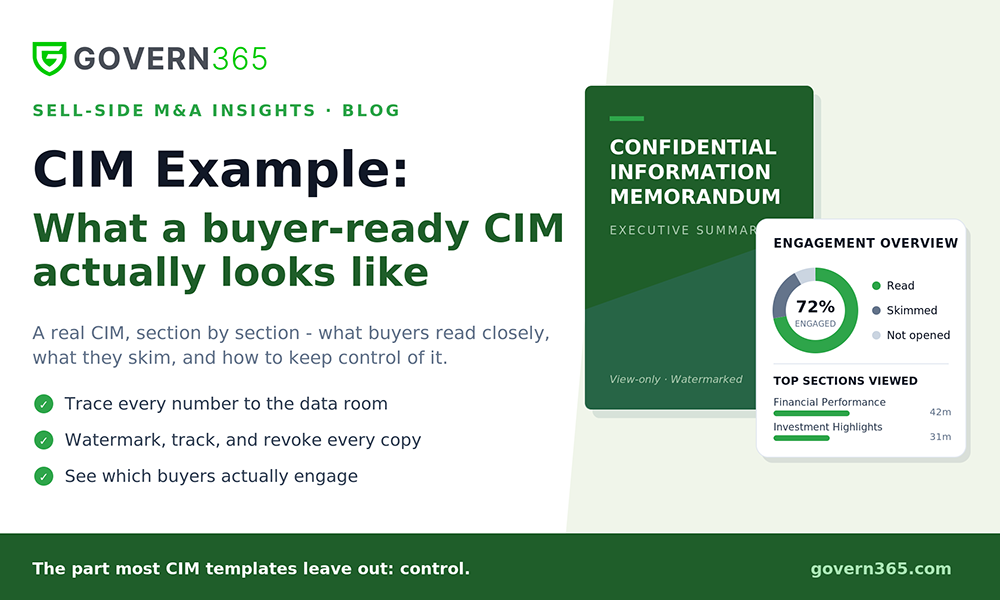
It’s an unnecessary blindness. When the CIM is delivered through a governed environment instead, the deal team can see which buyers opened it, which sections they sat in, and for how long – per bidder. That’s not vanity data. The strategic who spent forty minutes in your financials and came back twice is telling you something the one who skimmed the executive summary is not. Bankers who run their process on Govern 365 get to read seriousness weeks before anyone writes a bid.
Keeping control after the CIM leaves your hands
Here’s how the lifecycle works when it’s done right, and this is where Govern 365 earns its keep.
The CIM gets drafted in Word, inside the seller’s own Microsoft 365 tenant – genuine co-authoring across banker, counsel, and management, full version history, draft watermarks, and Purview sensitivity labels on the file from the first keystroke. A CIM typically survives fifteen or more revisions over several months; that entire mess happens under governance instead of over email. If AI helps with the drafting, it works over the deal corpus inside the tenant. The draft never transits somebody else’s AI service, which is a question your counsel is going to start asking if they haven’t already.
Then distribution. A buyer signs the NDA, and the signature itself provisions their access: view-only, watermarked with their name, revocable in one click when they drop out of the process. There’s no attachment to forward and no orphaned copy you can’t account for. When the deal closes, one audit trail runs from the first draft to the certificate of destruction.
That’s really the whole argument. An example shows you a document. Buyer-ready means the document plus the control system wrapped around it.
Frequently asked questions
A typical CIM example runs 30-60 pages: executive summary, investment highlights, company overview, products and customers, market opportunity, historical and projected financials, growth opportunities, and a transaction overview. It’s professionally produced, watermarked, and shared only with buyers under NDA.
Long enough to earn a credible indication of interest, short enough that people actually read it. For most mid-market deals that’s 30-60 pages; lower-middle-market CIMs often land at 20-40. Detail beyond that belongs in the data room, released by diligence stage.
The investment banker or M&A advisor drafts it, with heavy input from the CEO, CFO, and counsel. Plan on months of revision – which is why co-authoring, version history, and draft watermarking matter long before any buyer sees page one.
The teaser is a one-to-two-page anonymous summary sent broadly to test interest. The CIM is the full, named story, shared only after the NDA is signed. We break this down in CIM vs. teaser.
It’s usually the most sensitive marketing document a company will ever produce. The buyer-ready answer: view-only access provisioned by the NDA signature, a watermark carrying each recipient’s name, engagement tracking, and one-click revocation – not an email attachment you hope nobody forwards.
Yes, and it’s increasingly common for first drafts and iteration. The question that matters is where the AI runs. Govern 365 supports AI-assisted CIM drafting inside the seller’s own Microsoft 365 tenant, so deal documents never leave the boundary or train someone else’s model.
Want to see the full CIM lifecycle live? Bring your next process – or a hypothetical one – and we’ll walk drafting, NDA-gated distribution, per-bidder analytics, and revocation inside a Microsoft 365 tenant. Book a personalized demo.