Organizations have relied on Virtual Data Rooms (VDRs) for decades to support high-stakes business initiatives such as mergers and acquisitions, fundraising, due diligence, audits, legal reviews, and corporate transactions.
For many organizations, the data room has become synonymous with secure collaboration.
However, today’s business environment has evolved. Sensitive information no longer lives exclusively inside a data room. It moves between employees, external stakeholders, advisors, auditors, investors, attorneys, and business partners long before a project starts and often remains accessible long after a transaction ends.
As a result, organizations are discovering that securing a data room is only part of the challenge.
The real objective is protecting sensitive information throughout its entire lifecycle.
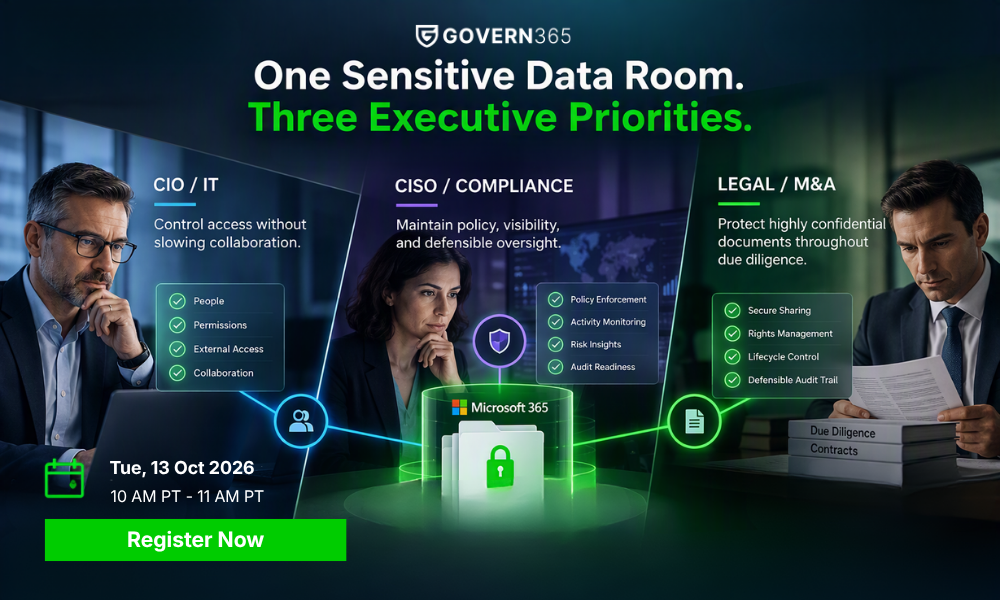
That shift in thinking is the focus of our upcoming webinar, “Beyond the Data Room: A Continuous Data Protection Framework,” where Niraj Tenany, CEO of Netwoven and visionary behind Govern 365, will introduce a practical framework for securing information before, during, and after external collaboration initiatives.
The Traditional VDR Model Has a Blind Spot
Traditional Virtual data rooms were designed to solve a specific problem: providing a controlled environment for sharing confidential information during critical transactions.
While that remains important, most security and compliance teams now recognize that sensitive data begins its journey long before it reaches a VDR.
Questions organizations should ask include:
- Where is sensitive information collected?
- How is it validated before sharing?
- Who has access to it during collaboration?
- Can activity be monitored throughout the process?
- What happens after the project ends?
- How can organizations prove access was removed and data was governed appropriately?
These questions highlight a larger challenge.
The transaction is only one phase of the data lifecycle.
The data itself continues to exist before, during, and after the project.
Data Is Living. Risk Exists at Every Stage.
Sensitive information follows a lifecycle. Every stage introduces unique risks that organizations must address.
Stage 1: The Birth of Data
Before a project even begins, documents must be gathered from internal departments, external sources, advisors, and partners.
Unfortunately, intake processes often rely on:
- Email attachments
- Shared network folders
- Public links
- Consumer-grade file sharing services
- Manual collection methods
This creates governance gaps from day one. Sensitive information may already be duplicated, misplaced, or shared without visibility before it ever reaches a secure workspace.
Stage 2: The Life of Data
As collaboration expands, the number of participants grows.
Today’s deals and business initiatives frequently involve:
- Executives
- M&A teams
- Legal advisors
- Compliance teams
- Auditors
- Investors
- Third-party consultants
Without proper controls, organizations face:
- Unmanaged downloads
- Excessive permissions
- Limited audit visibility
- Data duplication
- Unauthorized sharing
- Increased compliance exposure
As collaboration increases, so does risk.
Stage 3: The Resting State of Data
This is often where governance efforts break down.
The project closes.
The deal completes.
The audit ends.
Yet:
- Guest users may still have access.
- Shared links may remain active.
- Copies of documents may continue circulating.
- Retention policies may not be consistently applied.
- Closure evidence may be difficult to produce during an audit.
The organization assumes security has been maintained, but in many cases, the greatest governance gaps appear after collaboration ends.
The Cost of Leaving Data Unprotected After the Deal Closes
Many organizations focus heavily on protecting information during active collaboration but invest considerably less effort in post-project governance.
This can create significant operational and compliance risks.
Imagine these scenarios:
- A former advisor still has access to confidential documents months after a transaction closes.
- Sensitive files remain accessible through previously shared links.
- Legal teams cannot prove when external access was revoked.
- Audit logs are fragmented across multiple systems.
- Duplicate copies of critical documents remain outside governed repositories.
In regulated industries, these issues can create compliance challenges. In corporate transactions, they can increase legal exposure and undermine stakeholder confidence.
The reality is simple:
A project may end, but the responsibility to govern sensitive data does not.
Organizations need a consistent methodology for protecting information from initial intake through final disposition.
Beyond the Data Room: Introducing the SECURE Framework
To help organizations address these challenges, Govern 365 has developed the SECURE Framework.
SECURE represents six critical stages required to establish continuous protection across the information lifecycle.
S – Setup
Define workspace architecture, folder structures, permissions, and governance policies before sensitive information enters the environment.
E – Enroll
Ensure every stakeholder, document, and data source is properly onboarded through a secure, controlled process.
C – Control
Apply protection mechanisms including access controls, encryption, watermarking, information protection, and granular permissions.
U – Unite
Enable secure collaboration among internal and external participants while maintaining centralized governance and oversight.
R – Review
Monitor activities continuously through auditing, reporting, compliance reviews, and visibility into user behaviour.
E – Exit
Close workspaces confidently through automated access revocation, retention enforcement, auditing, archiving, and defensible disposition procedures.
Why Microsoft 365 Is the Foundation for Continuous Protection
Many organizations already trust Microsoft 365 for productivity and collaboration.
The problem is that external collaboration workflows are often managed through disconnected systems that create additional governance challenges.
A Microsoft-native approach enables organizations to extend security, compliance, identity management, and governance controls into their external collaboration processes.
During the webinar, attendees will see how capabilities such as:
- Microsoft Entra ID-based access control
- Dynamic watermarking
- Rights Management (DRM)
- Sensitivity labeling
- Audit tracking
- Controlled guest access
can help deliver governance and security while reducing operational complexity.
What You’ll Learn During the Webinar
This executive session will explore how organizations can:
✅ Reduce data sprawl across the collaboration lifecycle
✅ Protect sensitive information before, during, and after transactions
✅ Improve governance and compliance readiness
✅ Coordinate multiple stakeholders through secure workflows
✅ Establish defensible workspace closure processes
✅ Leverage Microsoft 365 for secure external collaboration
✅ Maintain visibility and auditability throughout every engagement
Attendees will also experience a live Govern 365 demonstration showcasing secure workspace creation, NDA execution, stakeholder collaboration, controlled Q&A, and immutable auditing capabilities inside Microsoft 365.
Register for the Webinar
Beyond the Data Room: A Continuous Data Protection Framework
Date: October 13, 2026
Time: 10:00 AM PT | 1:00 PM ET
Duration: 60 Minutes
Speaker: Niraj Tenany, CEO, Netwoven & Visionary Behind Govern 365
Modern organizations can no longer afford to think of data protection as a single event tied to a specific transaction.
Security, governance, and compliance must extend across the entire lifecycle of sensitive information.
Join us to discover how the SECURE Framework helps organizations move beyond traditional data rooms and establish continuous protection from data intake to defensible workspace closure.
Register now to learn how Govern 365 helps organizations secure sensitive information at every stage of external collaboration while leveraging the power of Microsoft 365.
Continuous data protection is the practice of securing sensitive information throughout its entire lifecycle, from creation and collaboration to retention and disposal.
A virtual data room secures information during a transaction, but organizations must also govern data before collaboration begins and after the project concludes.
Microsoft 365 provides identity management, access controls, sensitivity labels, auditing, and compliance capabilities that help secure external collaboration.
The SECURE Framework is Govern365’s approach to protecting information through Setup, Enroll, Control, Unite, Review, and Exit stages.