Manage Every Stage of the Deal in One Secure Platform
- One Platform for Every Deal Stage: Govern 365 supports the entire M&A lifecycle - from preparation and marketing to diligence, closing, and beyond - in one governed workspace.
- Replace Fragmented Deal Tools: Eliminate scattered emails, spreadsheets, CRMs, and file-sharing platforms with one centralized environment for documents, people, workflows, and AI.
- Microsoft-Native Security & Governance: Keep sensitive deal data protected within your Microsoft 365 tenant using Entra ID, Microsoft Purview, and DLP.
Trusted by deal teams & security officers | Audit-ready logs | Role-based access | Fast setup





The entire seller journey – from first document to final payment – inside your own Microsoft 365 tenant
Selling a company is a seventeen-stage journey: producing the evaluation documents, enhancing value, going to market, building the buyer pool, distributing teasers and the CIM, running the auction, negotiating, closing, and getting paid. A traditional virtual data room shows up at exactly one of those stages – “build data room” – and goes dormant after diligence. Everything else lives in email threads, Excel trackers, the banker’s CRM, and e-signature tools, with the seller’s most sensitive information scattered across all of them, mostly in third-party clouds. Govern 365 collapses that stack into one governed environment where documents, people, workflows, and AI operate under a single security model the seller already owns: Entra ID, Microsoft Purview, and DLP. The data room stops being a phase of the deal and becomes the operating system of the deal.

The problem: one deal, five disconnected tools
The sell-side process is the most confidentiality-critical project a company will ever run, and it is executed on the least governed stack in the enterprise. CIM drafts and buyer questions travel by email, forwarded to anyone and revocable by no one. The buyer pool and bid comparisons live in Excel, versioned by “final_v7.xlsx.” Buyer contacts, tiers, and status sit in the banker’s CRM – deal intelligence the seller never sees. NDAs are signed in an e-signature tool that has no connection to the access those NDAs are supposed to grant. And for the diligence stage only, the company’s most sensitive documents are uploaded to a third-party VDR cloud, at a per-page or per-deal price, then exported and abandoned when the deal closes.
The result is a deal with no single security model, no single audit trail, and no single owner – during the precise months when a leak can kill the transaction, spook employees and customers, or hand a strategic bidder information it should never have had. And the months of preparation before a buyer ever appears, when the Business Evaluation Document, valuation, and CIM are being drafted, are completely invisible to a legacy VDR: the most sensitive collaboration of the entire process happens with no protection at all.
The model: three workspaces and an archive
Rather than one flat data room, Govern 365 structures the sale as progressive workspaces that mirror the journey’s natural trust boundaries. Access widens only as trust is earned – and is revocable at every gate.
Preparation Workspace (seller + investment banker; journey stages 1-3)
Where the Business Evaluation Document, valuation and evaluation report, value-enhancement roadmap, teaser, and CIM get drafted – with real Word and Excel co-authoring, version history with draft and final states, draft watermarks, and Purview sensitivity labels applied from the first keystroke. This phase is invisible to legacy VDRs, yet it is months of the most sensitive collaboration in the whole process. It is also the natural on-ramp: the deal starts in Govern 365 before a single buyer exists. (Stage 4, the personal wealth review, is deliberately scoped to the seller’s wealth advisor.)
Marketing Workspace (the buyer funnel; stages 5-9)
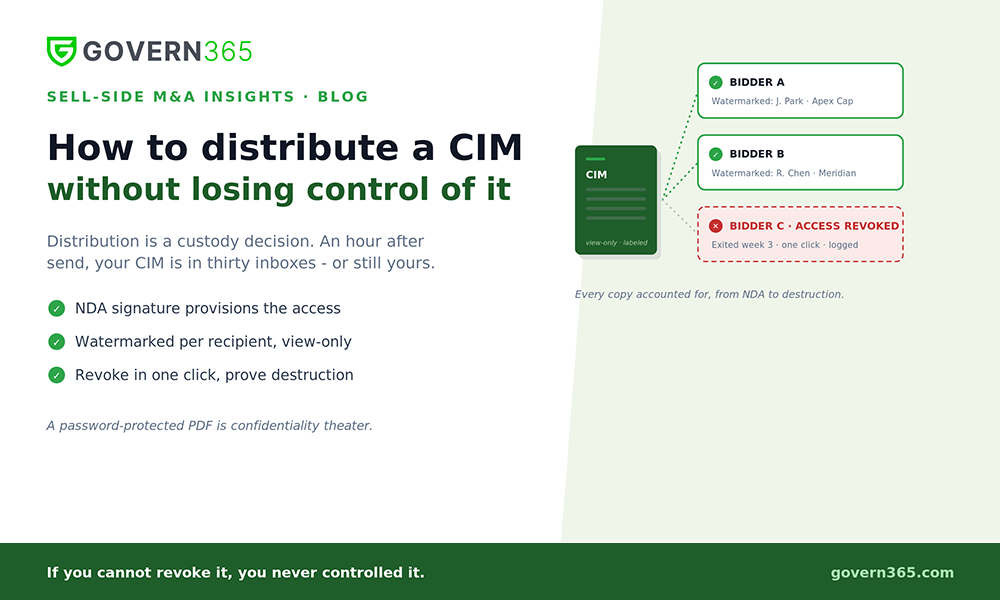
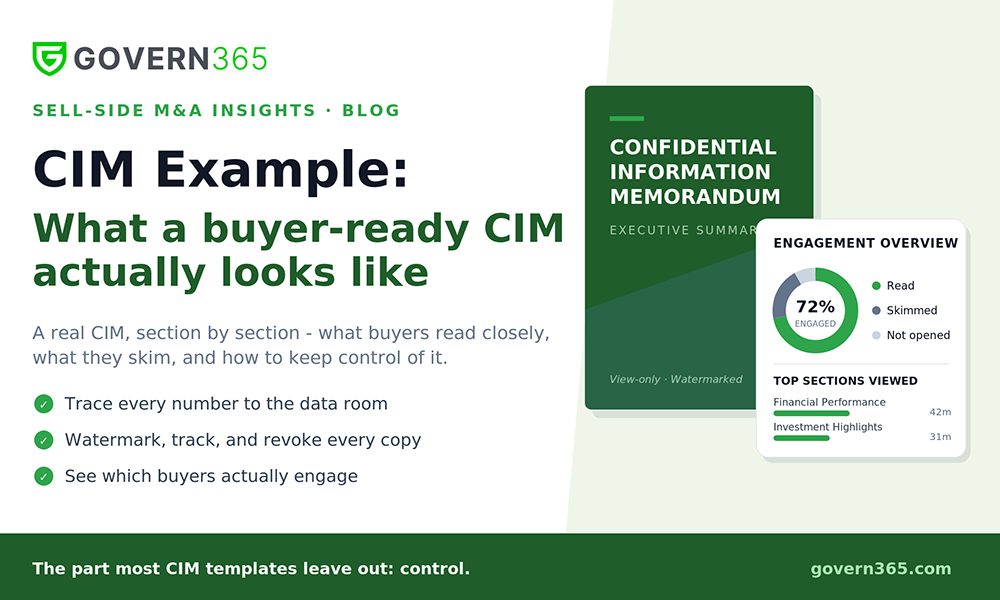
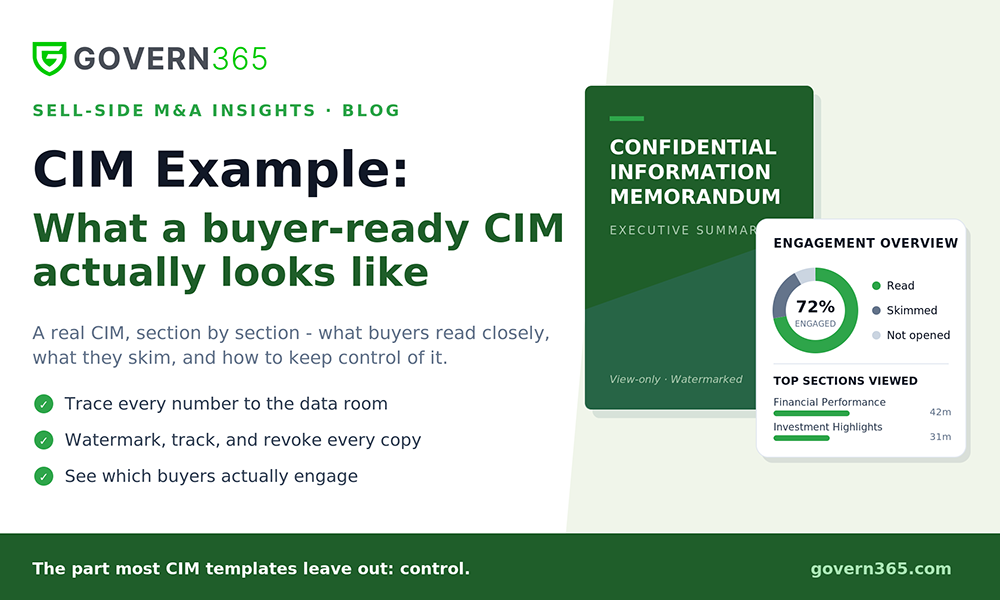
A buyer pool registry holds each prospective bidder – strategic versus financial, tier, contacts, status. Anonymous teasers go out with engagement tracking. When a buyer signs the NDA, the signature event auto-provisions their Entra ID guest access to the CIM: view-only, watermarked per recipient, revocable the moment they drop out. Per-bidder analytics – who opened the CIM, which sections, dwell time – become intelligence the banker uses to gauge seriousness before IOIs arrive. “Build data room” stops being a stage of the deal; the room has existed since the first draft.
Transaction Workspace (the auction and diligence; stages 10-15)
Staged, permission-tiered access that deepens as bidders advance: IOI submitters see the core index, LOI finalists get full diligence, and a clean room isolates competitively sensitive material – customer contracts, pricing – for strategic buyers’ outside counsel only. A structured Q&A module routes buyer questions to the right seller-side experts, with answers published per-bidder or to all. Management presentations, process letters, bid comparison grids, LOI redlines, and disclosure schedules – linked directly to the VDR documents they reference – all live here.
Closing and Archive (stages 16-17)
An auto-generated closing binder, an immutable audit record of every access event across the whole journey, archive for the seller under regulated retention where required, and a Certificate of Destruction for buyer copies. The deal ends; the record does not.
Progressive trust, not a flat repository
Govern 365 mirrors the natural progression of an M&A transaction. Sensitive preparation remains internal until buyers are engaged, marketing activities are governed independently, diligence access expands only as bidders advance, and the completed transaction is preserved with a permanent audit record. Every workspace reflects a distinct trust boundary, ensuring access is granted only when required and revoked immediately when it is no longer needed.
Capability Mapping: Feature to Value
| Feature pillar | What it delivers | Journey stages |
|---|---|---|
| Deal preparation | Collaborative authoring rooms, versioning with draft/final states, readiness scorecard and value-enhancement task tracker (Planner-backed), AI-assisted CIM and BED drafting inside the tenant | 1-3 |
| Buyer funnel management | Buyer pool registry, teaser distribution with tracking, NDA templates with e-signature integration, NDA-triggered access provisioning, one-click revocation | 5, 7-8 |
| Controlled distribution | Per-recipient dynamic watermarking, view-only enforcement, Purview labels that travel with files, DLP policies against forwarding, printing, and screenshot exfiltration | 9 |
| Process orchestration | Stage-gated permissions that mirror the auction (teaser, CIM, diligence, clean room), Q&A workflow, request list management, milestone timeline reflecting the journey in the UI | 10-15 |
| Deal intelligence | Per-bidder engagement analytics, heatmaps of document interest, audit-grade activity logs, AI-powered Q&A over the data room (Gideon AI as the diligence copilot) | 5-15 |
| Lifecycle closure | Closing binder assembly, post-close archive, Certificate of Destruction, retention policies for regulated sellers | 16-17 |
Why tenant-native beats renting a room
Intralinks and Datasite rent you a room for one stage of your deal. Govern 365 runs all seventeen – in your own Microsoft 365 tenant, under your own security, with AI that never leaves your boundary.
The difference is structural, not cosmetic. In a rented VDR, your documents migrate to a vendor’s cloud, buyers get vendor logins outside your identity system, and the process around the room – buyer tracking, NDAs, Q&A email – runs unprotected. In Govern 365, documents never leave the tenant; buyers are governed Entra ID guests under conditional access; Purview labels and DLP travel with every file; and the entire process, from the first draft of the BED to the Certificate of Destruction, produces one continuous, audit-grade record. For the banker, that means a tighter auction: stage-gated access that mirrors the process, engagement intelligence before IOIs arrive, Q&A that is routed and tracked, and no migration weekend before go-to-market. For the seller, it means the crown jewels of the company are protected by the same controls its auditors have already accepted.
Request a DemoOutcomes
The most sensitive months of the deal – preparation – are governed from the first keystroke, not from VDR provisioning
Every buyer touchpoint, from teaser to clean room, is provisioned, watermarked, tracked, and revocable through one identity system
The banker runs the auction on per-bidder intelligence instead of inbox archaeology
Diligence Q&A, disclosure schedules, and bid materials are linked to the documents they reference, in one place
After closing: a complete archive for the seller, provable destruction for everyone else, and an audit record spanning all seventeen stages
No deal document, and no deal AI, ever transits a third-party cloud
Frequently Asked Questions
A traditional VDR covers one stage of the seller’s journey – hosting documents during diligence – in the vendor’s cloud. Govern 365 runs the entire journey, from drafting the CIM to the Certificate of Destruction, inside the seller’s own Microsoft 365 tenant. Preparation, buyer marketing, NDA-gated distribution, tiered diligence, closing, and archive all operate under one security model: Entra ID, Purview, and DLP.
No. Documents are drafted, shared, and archived inside your tenant. Buyers and their advisors access them as governed Entra ID guests, with view-only enforcement, per-recipient watermarking, and one-click revocation. Nothing is uploaded to a third-party VDR cloud.
The NDA is executed through e-signature integration, and the signature event automatically provisions that buyer’s Entra ID guest access to the CIM – view-only and watermarked per recipient. If the buyer exits the process, access is revoked in one click, and the audit trail shows exactly what they saw and when.
Yes. The Transaction Workspace supports tiered access – IOI submitters, LOI finalists – plus a clean room that isolates customer contracts, pricing, and other competitively sensitive material for strategic buyers’ outside counsel only.
Govern 365 assembles the closing binder, retains the full record in the seller’s tenant under applicable retention policies, revokes and destroys buyer copies, and issues a Certificate of Destruction. The seller keeps an immutable audit record of every access event across the whole journey.
Yes – AI assists CIM and BED drafting in preparation and powers Q&A over the data room during diligence (Gideon AI). It operates over the deal corpus inside your Microsoft 365 boundary. Deal documents never transit, and never train, a third-party AI service.
Both. The seller owns the environment; the banker runs the process in it – buyer pool, teaser distribution, engagement analytics, Q&A routing, bid grids, and the milestone timeline. Most bankers find it a tighter auction than a VDR plus spreadsheets plus email.
Insights | Blog