Non-Profit Data Room for Microsoft 365
Protect every donor record, beneficiary file, and board document inside your own Microsoft 365 tenant.
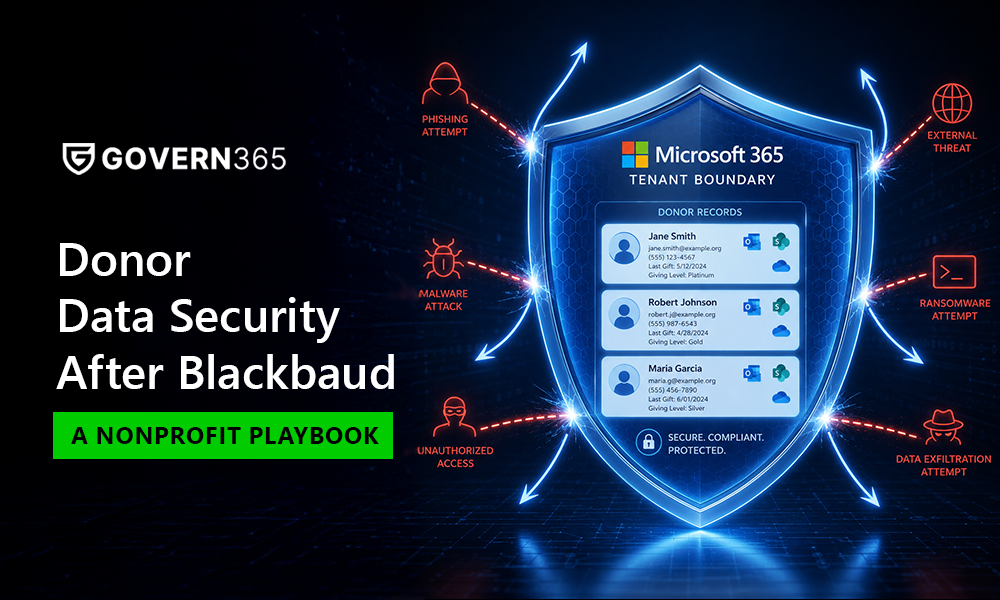
After the Blackbaud breach, the question is no longer "which third-party VDR should we trust?" It is: why is donor data leaving Microsoft 365 in the first place? Govern 365 keeps it inside.
The Only Microsoft 365-Native VDR Built for Mission-Driven Organizations
In the non-profit sector, your data is your reputation. Donor financials, beneficiary PII, audited statements, board materials, grant applications, and abuse-investigation files - the records your mission depends on - sit at the center of an escalating cyber-threat landscape. Legacy VDRs and donor-management SaaS platforms force you to copy that data into vendor clouds you don't control. The result, as 13,000+ non-profits learned in 2020, is board-level liability you can't easily explain. Govern 365 keeps everything inside the Microsoft 365 tenant your IT team already governs.Trusted by mission-driven organizations | Audit-ready logs | Role-based access | Fast setup

UPCOMING WEBINAR
OCTOBER 13, 2026 | 10:00 AM PT
M365 VDR – How to Enable Security at Every Stage of the Sensitive Data Lifecycle Inside M365.
Stewarding the Mission: From Donor Trust to Beneficiary Safety
The journey from donation to impact is plagued by data-trust failures. Microsoft’s Digital Defense Report 2024 ranks non-profits as the 4th-most-targeted sector by nation-state actors. Okta’s 2025 Nonprofits at Work report puts them at #2 overall. Cloudflare’s Project Galileo measured a 241% increase in DDoS attacks against civil-society organizations between 2024 and 2025. Yet 70% of non-profits still operate without a formal cybersecurity policy, and 80% have no documented incident-response plan.
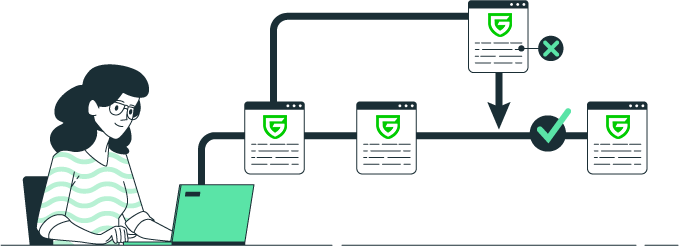
Stewarding the mission requires a shift from third-party storage to in-tenant governance. Govern 365 eliminates the complexity of donor, grantor, beneficiary, and auditor collaboration while ensuring every action is documented for the next AG inquiry, IRS Form 990 review, HHS OCR audit, or single-audit cycle.
How we power the non-profit lifecycle

Donor & Major-Gift Stewardship
Securely share audited financials, capital-campaign decks, and impact reports with HNW donors and family foundations. Watermarking, view-only DRM, time-bound access, and page-level engagement analytics – all without standing up a parallel VDR vendor that itself becomes a third-party breach risk.

Beneficiary PII & PHI Protection
Patient records, abuse-survivor files, refugee data, child-sponsorship details, immigration status. Microsoft Purview classification plus persistent rights management means data stays protected even after download, even after the file leaves your tenant.

Board & Governance Rooms
Replace board-portal sprawl. Distribute board packs, executive-compensation data, and audit-committee files with director-level granular access, no print or download, and an immutable activity log -inside the Teams and SharePoint stack your directors already use.

Grant & Audit Diligence
Foundation grantors, IRS Form 990 reviewers, single-audit (Uniform Guidance) firms, HHS OCR investigators, state attorneys general. Stand up a read-only auditor portal in seconds with structured Q&A, scoped access, and forensic chain of custody.
VDR Savings Calculator
A smarter way to manage sensitive data. Move your VDR inside your own tenant and stop the vendor cloud leak.
Based on 2026 Subscription model.
The Non-Profit Toolkit
Donor wealth profiles, capital-campaign decks, and major-gift correspondence stay in your Microsoft 365 tenant. No vendor cloud. No “trust us, we deleted it” ransom claims like the Blackbaud postmortem. Your CRM, your fundraising data, your audit trail – all inside the security boundary your IT team already governs.
Automatically classify and redact SSNs, patient identifiers, abuse-survivor names, immigration status, and donor financial details across thousands of documents using Microsoft Purview AI plus Govern 365 policy automation. HIPAA, GDPR, CCPA, and state breach-notification compliance built in.
Foundation grantors and OIG auditors expect structured Q&A. Govern 365 routes questions to the right SME, tracks responses end-to-end, and builds a permanent FAQ knowledge base so you’re never re-answering the same compliance question for the next funder cycle.
After Blackbaud, 50 state attorneys general and the SEC have signaled aggressive enforcement of breach-notification and reasonable-security obligations. Every Govern 365 access event is timestamped, identity-tied, and forensically retainable. Your defense is built in, not reconstructed under deposition pressure.
Native Microsoft 365 Sovereignty. No “Black Box” Risk.
Non-profit IT leaders learned the hard way in 2020 that storing donor PII in a third-party SaaS platform creates board-level risk. The Blackbaud breach impacted 13,000+ non-profit customers across about a quarter of Blackbaud’s customer base — including Memorial Sloan Kettering, Save the Children, World Vision, Boy Scouts of America, CARE Canada, Human Rights Watch, and hundreds of universities and hospitals. Settlements: $49.5M to 49 states, $6.75M to California, $3M to the SEC.
Govern 365 leverages the Microsoft Purview, Entra ID, and SharePoint investments you already pay for — so your most sensitive data never leaves the security boundary your team controls.
Request a DemoSovereign Data. Intelligent Reporting. Federation at Scale.
100% Data Sovereignty
Donor records, beneficiary PII, board minutes, and grant correspondence stay in your Microsoft 365 tenant.
Microsoft 365 Copilot for Mission Reporting
Use Copilot to summarize grantor reports, identify program risk patterns, and draft donor updates inside secured workspaces.
Federation-Ready Architecture
Designed for parent-and-affiliate non-profits. Roll out from HQ; scale to every affiliate.
Frequently Asked Questions
A virtual data room is not a software category, it is a set of outcomes: controlled access, persistent file protection, evidence-grade audit, and clean close-out. Non-profits need those outcomes any time they handle board materials, donor records, grant audits, M&A diligence, beneficiary data, or legal investigations. You do not necessarily need a separate VDR product. You need a way to deliver the outcomes.
Roughly 60 percent of non-profits surveyed have suffered a successful cyber incident in the past two years. Attacks on the sector are rising about 30 percent year over year, and the average global cost of a data breach has crossed $4.4 million. Recent named incidents include the ICRC breach (515,000 vulnerable people exposed), the Blackbaud cascade (donor data across hundreds of charities), and Little Red Door (federal grants pulled after a ransomware attack).
Free file sharing is fast, but it is link-based rather than identity-bound, permissions sprawl over time, and audit logs are thin and scattered. When an auditor, foundation officer, or regulator asks “show me everyone who viewed this file in the last 90 days,” the honest answer is usually silence. Free sharing is built for speed, not for defensibility.
Traditional VDRs were designed for Wall Street M&A: a defined document set exposed to a defined buyer for a defined window. Non-profit work does not look like that. Capital campaigns run for three years, grant cycles for four, litigation holds indefinitely. Per-page or per-month pricing punishes exactly the kind of long-running, document-heavy work non-profits do most.
A Microsoft 365 tenant out of the box is not a virtual data room, but it is the substrate from which one can be built. Govern 365 is the operating discipline that sits on top: it provisions rooms from templates, enforces identity binding via Entra ID, applies sensitivity labels via Purview, captures evidence in the Unified Audit Log, and shuts rooms down on a defensible schedule. The result is VDR-grade trust without leaving M365.
A traditional VDR is a separate platform with a separate identity store, separate permissions model, separate audit log, and separate offboarding process. Govern 365 has none of those. It uses your Microsoft tenant’s identity, classification, and audit fabric. For a non-profit IT team of three, that means one platform to operate, one compliance posture to maintain, and one source of truth to defend in an audit.
Controlled access (identity-bound, not link-based), persistent file protection (sensitivity labels that travel with the file), evidence-grade audit (every access event captured and queryable), and clean close-out (materials retain on policy when the matter ends, with a defensible record set preserved). Any solution claiming to be a virtual data room must deliver all four. Govern 365 delivers them inside Microsoft 365.
Three services do most of the work. Entra ID is the identity fabric, deciding who you are and what conditions apply at every session. Purview is the information protection fabric, applying sensitivity labels and retention policies that travel with the file. The Unified Audit Log is the evidentiary fabric, capturing every meaningful action across SharePoint, Teams, OneDrive, and Exchange.
Yes, when configured correctly. Microsoft 365 supports tenant-level and per-workload data residency in dozens of geographies and meets HIPAA, GDPR, FedRAMP, and many sector-specific compliance frameworks. Govern 365 applies the right residency, encryption, and access controls per matter so that beneficiary data created in country stays in country, donor data in the EU stays in the EU, and the audit trail proves it.
Inside your Microsoft 365 tenant, in the geographies you have chosen. Govern 365 does not create a parallel data store, does not move documents to a vendor’s infrastructure, and does not require you to negotiate a separate data processing agreement. The data residency you have already negotiated with Microsoft applies.
Yes. Govern 365 layers on top of the Microsoft Unified Audit Log and Purview retention. It does not replace them. Your existing log retention period, eDiscovery configuration, and records management policies continue to apply. Govern 365 makes querying that evidence easier per matter, with one-click reports that the matter owner can generate without involving IT.
Insights | Testimonial


Insights | Blog