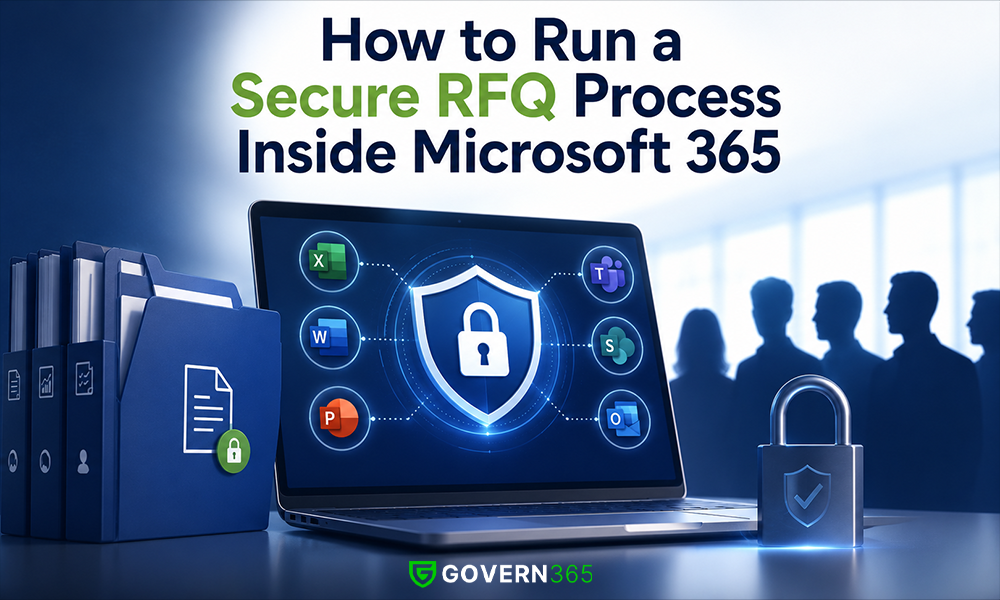
Most sourcing teams still run their RFQs out of an inbox. Specs go out as email attachments, clarifying questions trickle back one at a time, and bids land as PDFs that someone hand-copies into a master spreadsheet. It works, until a vendor challenges the outcome and you discover that your “audit trail” is a tangle of email threads. A secure RFQ process closes that gap by moving the entire request for quotation process into a controlled, tenant-native workflow: isolated vendor data rooms, one governed Q&A channel, and a complete record of who saw and did what, when. This post walks through what that looks like and how to stand it up inside Microsoft 365.
Why the email-based RFQ is a liability
The email-based request for quotation process fails in five predictable ways. Specs are emailed to a vendor list, and the buyer then spends days chasing responses. The same clarifying questions get answered one at a time, inconsistently, so some vendors quietly end up better informed than others. Bids arrive buried in PDFs and reply chains and get copied by hand into a comparison sheet. There is no reliable record of who received the package, who opened it, or what was disclosed. And when a losing bidder or an internal auditor challenges the process, there is nothing defensible to point to.
None of this is a discipline problem. It is a tooling problem. Email was never designed to keep competing vendors isolated from one another, to enforce equal information, or to produce a tamper-evident log. Competitive sourcing needs all three.
What a secure RFQ process looks like
A secure RFQ process treats the sourcing event as a governed workspace rather than a mail-merge. The RFQ package – specifications, bill of materials, drawings, terms, response templates, and deadlines – is published once into a controlled location. Each vendor is granted access to their own isolated room and can see only their own room: not other bidders, not their identities, not their questions or activity. Isolation is enforced by permissions, not by the buyer remembering to BCC.
This is the RFQ virtual data room model, and it is the same pattern that mergers, financings, and audits have used for years to share sensitive documents with outside parties under control. Applied to procurement, it means sensitive sourcing information never leaves your environment and you never hand competitive bid data to an external third-party portal. Your RFQ, your vendors, your data, your tenant.
Fix the vendor Q&A problem with one governed channel
The single biggest source of unfairness in sourcing is scattered vendor Q&A. When questions arrive by email, answers are inconsistent and unevenly distributed. A governed RFQ process routes every vendor question through one channel. Questions go to the buyer or are routed to the right subject matter expert in engineering, legal, or finance, and answers are published back into the same thread so they live in one place with full history.
That single change eliminates the most common integrity complaints in competitive sourcing. Every question is logged, every answer is attributable, and nothing depends on an inbox.
Fairness by design: equal information for every bidder
The strongest fairness posture in a competitive RFQ is the equal-information principle: when one vendor asks a clarifying question, the anonymized answer is shared with every bidder so no one gains an advantage simply from having asked. A modern secure RFQ process should support both modes by permission. Some clarifications are genuinely vendor-specific and should be answered privately in that vendor’s room. Formal solicitation-period clarifications should be broadcast to all rooms with the asker’s identity withheld. Making that a deliberate, configurable choice is what separates a defensible process from a hopeful one.
From email threads to a defensible audit trail
The reason this matters beyond convenience is the procurement audit trail. In a governed process, every view, download, question, and answer is captured with a timestamp. When an auditor or a challenged bidder asks what happened, you generate a complete activity and disclosure report on demand rather than reconstructing it from memory and email. For regulated and government-adjacent buying, that record is not optional – rules such as the Procurement Integrity Act prohibit disclosing sensitive bid and source-selection information before award, and you need to be able to show that you did not.
A clear audit trail also protects the outcome. When the process is provably fair and fully logged, a losing bidder has far less room to allege bias, and you have the evidence to defend the award.
The cost of a messy front end
The RFQ is where competitive value is captured or quietly lost, and the numbers around manual sourcing make the case on their own:
- The median cost to cut a single purchase order is roughly $55 before any material spend, and the median sourcing cycle runs near 60 days on manual processes (APQC benchmarks).
- A single complex RFQ can consume 8 to 10 hours of a skilled procurement professional’s time when it is run by hand (published procurement industry analysis).
- Organizations lose an average of 11% of contract value to leakage, climbing to 15% or more in complex supplier ecosystems, and a meaningful share of that starts at sourcing (World Commerce & Contracting).
A messy, email-based, unauditable front end is the first leak in the pipe. Tightening it is one of the cheapest efficiency wins available to a sourcing team.
How Govern 365 powers a secure RFQ process in Microsoft 365
Govern 365 runs this entire pattern inside your own Microsoft 365 tenant, built on SharePoint and Entra ID rather than a separate vendor cloud. The RFQ package is published into a Govern 365 virtual data room, each vendor is granted an isolated room as a Member or Visitor, and the built-in Q&A module gives you the single governed channel for questions and answers with private or anonymized-broadcast responses. Microsoft Purview logs every action across every room, so the audit report is always one click away.
The result is a secure RFQ process that is sealed, fair, and auditable, that works inside the Microsoft 365 licensing and governance you already own, and that keeps competitive bid data where it belongs – in your tenant.
Frequently asked questions
A secure RFQ process is a request for quotation workflow where the sourcing package is distributed to vendors through isolated, permissioned data rooms, all vendor questions run through one governed Q&A channel, and every view, download, question, and answer is logged for a defensible audit trail. It replaces ad-hoc email distribution with a controlled, tenant-native workspace.
An RFQ virtual data room keeps each vendor isolated by permission so no bidder can see another bidder, their identity, or their activity. It governs document access, captures a full audit log, and centralizes vendor Q&A. Email cannot enforce isolation, equal information, or a tamper-evident record, which is why it creates fairness and audit risk.
A governed Q&A channel sends every vendor question through one place, routes it to the right responder, and lets you publish clarifications either privately to one vendor or anonymized to all bidders. Broadcasting clarifications to every bidder enforces the equal-information principle so no vendor gains an advantage from having asked.
Yes. A tenant-native RFQ process built on SharePoint and Entra ID keeps the sourcing package, vendor responses, and the audit log inside your own Microsoft 365 environment. Sensitive bid data is never handed to an external third-party portal.
It captures who viewed and downloaded each document, who asked which question, who answered, and when – all timestamped. That record lets procurement generate a complete activity and disclosure report on demand for internal audit, compliance, or to defend an award if it is challenged.
No. In an isolated-room model each vendor sees only their own room. Other vendors, their identities, their questions, and their activity are hidden by permission. Clarifications are only shared across bidders when you choose to broadcast them anonymously.
It is well suited to it. Regulated sourcing requires that sensitive bid and source-selection information stay protected before award and that the process be auditable. Isolated rooms plus a complete, tamper-evident log directly support those requirements.
Take the next step
Book a Govern 365 RFQ data room demo to see isolated vendor rooms, governed Q&A, and on-demand audit reporting running in a live Microsoft 365 tenant. Prefer to read first? Pick up Secure by Design for the broader playbook on secure collaboration in Microsoft 365.