Anyone who has run more than a few M&A processes already knows the pattern. The VDR vendor quotes a starting figure that sounds reasonable. Halfway through diligence, the number has doubled. By closeout, it has doubled again. The deal team blames itself for the data volume. The CFO blames the deal team. Nobody blames the pricing model – even though that’s where the actual problem lives.
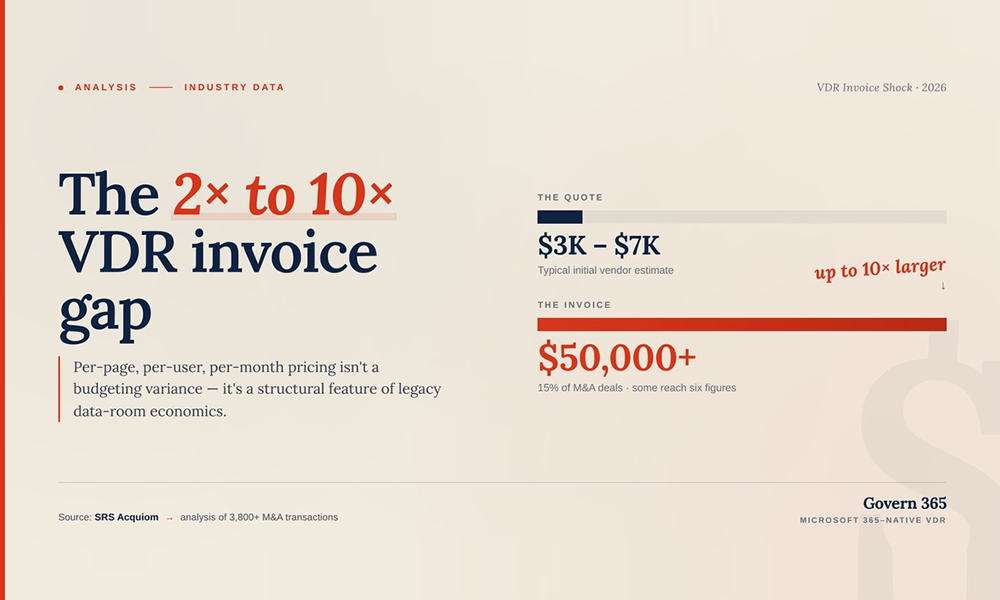
Independent data from SRS Acquiom – the M&A services firm that handles paying agent, escrow, and shareholder representation duties on thousands of deals – confirms that this isn’t anecdotal. In a recent analysis of more than 3,800 transactions where SRS Acquiom served as paying agent, more than 15% had VDR-related payments at closing exceeding $50,000, with some reaching six figures. SRS Acquiom also reports that initial fee quotes typically land between $3,000 and $7,000 – while final invoices commonly run two-to-ten times those amounts.
Two-to-ten times. That’s not a budgeting variance. That’s a structural pricing failure.
The pricing model is the problem, not the deal
The reason invoice shock is so consistent across vendors and deal sizes is that the leading legacy VDRs all use variants of the same metering model: per page, per gigabyte, per user, per month. Every primitive on that list scales with things deal teams cannot control or accurately forecast at the start of a process.
Page counts explode the moment a target’s data room includes large engineering drawings, multi-tab Excel files exported as PDFs, or the kind of regulatory dossiers that are routine in life sciences and energy diligence. Storage scales with multimedia evidence – board-meeting recordings, manufacturing video, scanned facility surveys – that almost every modern company now produces. User counts climb when the deal lengthens, when the buyer rotates in additional functional reviewers, or when sell-side advisors add their own analysts. Time-based fees compound when the deal slows down, which in the current environment is most deals.
The result: every variable that makes diligence successful also makes the invoice grow. The deal teams who do the most thorough work get punished hardest at billing time.
What “hidden” actually means
When industry observers describe these costs as “hidden,” it’s worth being precise about what that means. The fees themselves are disclosed in the contract – that isn’t the issue. What’s hidden is the forecast. A line item that reads “$0.85 per page per month” is impossible to estimate against until the diligence is already underway, which is to say, until you no longer have leverage to renegotiate. The vendor knows this. The pricing model exists because the vendor knows this.
This is also why the most common buyer reactions – pushing back on per-page rates, negotiating volume discounts, capping monthly storage – rarely solve the problem. They optimize a model that’s structurally designed to underquote and overcharge.
The architectural alternative
The cleaner answer is to remove the metering primitives that cause the problem in the first place. In a Microsoft 365–native VDR, deal content lives in your own SharePoint Online tenant. Storage is part of the Microsoft 365 license you’re already paying for. External users authenticate through Microsoft Entra ID B2B at no incremental per-user cost. Audit logs flow into your existing Microsoft 365 unified audit log. There is no vendor cloud to bill against, because there is no vendor cloud.
What the vendor (in this case, Govern 365) prices is the workflow layer – VDR provisioning, structured Q&A, dynamic watermarking, fence visibility, deal bible export, closeout – on a flat-rate, per-VDR basis. Unlimited users. Unlimited storage. No per-page fees. No archive charges. The number on the contract at signature is the number on the invoice at year end.
This isn’t a discount on the legacy model. It’s a different model.
What this changes for deal teams
Three practical consequences fall out of removing variable metering.
The first is that diligence stops being self-throttling. Deal teams stop pruning the data room to manage the page count. They upload everything that ought to be reviewable, knowing the invoice doesn’t move. Buyers get a more thorough room. Sellers get a faster path to a clean signal.
The second is that running multiple deals in parallel becomes financially viable for the first time. Legacy VDR pricing punishes serial-acquirer behavior – a corporate development team running five concurrent processes pays five times the page count. A flat-rate, per-VDR model lets the same team scale deal volume without scaling spend.
The third is that closeout stops being a billing event. In a legacy VDR, the deal closing triggers archive fees, export fees, and sometimes per-GB egress charges. In a Microsoft 365-native VDR, the data already lives in your tenant. Closeout is a state change, not an invoice.
The buyer’s move
The SRS Acquiom data isn’t an indictment of any single vendor – it’s a description of an entire pricing category. The take-home for anyone budgeting for a near-term transaction is to recognize that the per-page, per-user, per-month quote you’re about to sign is, by design, an opening number rather than a final one.
The alternative isn’t to negotiate harder. It’s to choose architecture that doesn’t meter the things that grow.
If you want to see what the math looks like against your current contract, our VDR Switch Calculator models the comparison directly. Enter your existing per-page rate, your typical deal size, and the number of deals you expect to run – the output is the year-one and year-three difference between continuing on a metered VDR and switching to a flat-rate, Microsoft 365-native model.
The invoice shock is preventable. It just requires changing the pricing primitives, not negotiating them.